Why Do Good Ideas Come When You're Walking?
The thing you couldn't push through at the keyboard starts connecting on its own.
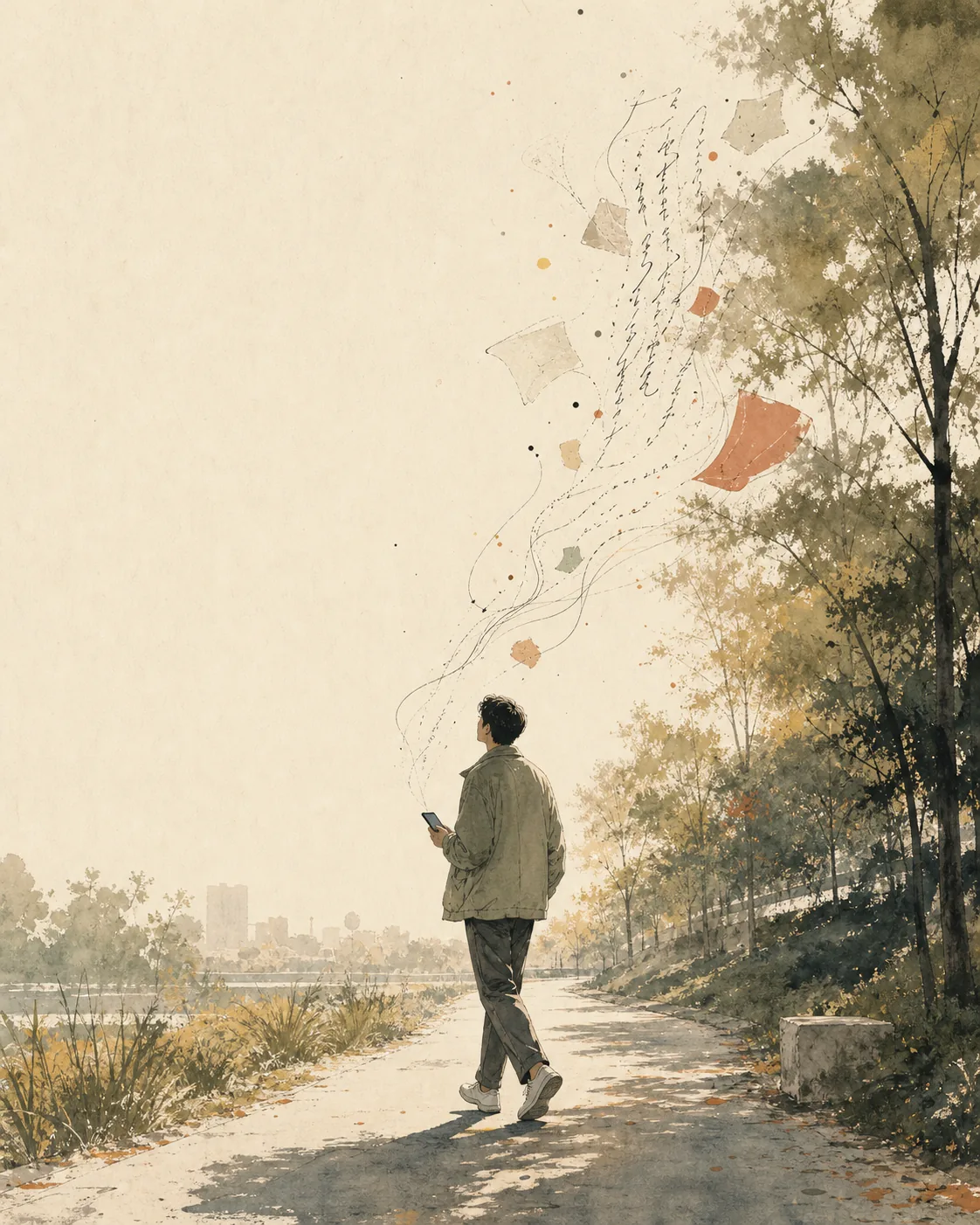
You're sitting at your desk, screen glowing, cursor blinking. The document is open, the title half-written, but thirty minutes in, the sentences still aren't right. You delete, rewrite, delete again. The harder you stare, the worse it gets.
Then you get up and go for a walk. Maybe just downstairs for coffee, maybe a loop around the park, maybe it's just the commute — you're not trying to think about it. Ten minutes later, a title appears. Then a structure, some examples, the tone of the opening paragraph. The thing you couldn't push through at the keyboard starts connecting on its own.
This isn't unusual. Writers, researchers, product managers, anyone who works with ideas — most of them know this feeling. Ideas don't always happen at the desk. They tend to show up while walking, in the shower, staring out a train window. The body leaves the chair, attention leaves the screen, and things that were disconnected start clicking together.
Why does moving the body make it easier to think? Why does the keyboard sometimes get in the way of ideas? And is voice input just faster typing — or something different altogether?
Walking loosens the mind
Sitting at a desk, it's easy to tighten up: I need to write this paragraph, I need to fix this headline, I need to deliver now. The more specific the task, the harder the focus. That tightness has its uses — it helps you work precisely. But in the early stages of an idea, what you need is a little looseness.
Walking provides exactly that.
The body is doing something rhythmic and low-effort. The eyes see roads, trees, light, people, sky — no longer just a blinking cursor. The brain hasn't stopped working; it's just shifted from "stare at one sentence" to "let many fragments collide in the background." Natural environments have a quiet restorative quality — unlike the desk, where notifications, windows, and task lists constantly pull at your attention. When focus relaxes, ideas have room to turn.
A Stanford experiment confirmed this intuition: compared to sitting, people walking performed significantly better on divergent thinking tasks — generating more possibilities, more angles, more uses. Psychologists have also found that the seemingly "distracted" state during creative work is often part of incubation. Low-demand activities — walking, washing dishes, daydreaming — aren't wasted time. They're when the brain is recombining information in the background. A study tracking the daily inspirations of physicists and writers found that the most important creative ideas often didn't emerge during focused desk work, but in the gaps — walking, commuting, doing chores.
This doesn't mean the more intense the exercise, the more ideas you get. Steady, rhythmic activities — walking, hiking, jogging, commuting on foot — are the ones most likely to leave room for thinking.
Ideas tend to come on the road, and there's probably no magic to it. When you're walking, you're finally not in a rush to turn a half-formed thought into a polished sentence.
The keyboard trap: ideas get pruned before they're fully grown
Writing is a remarkable invention. Spoken words vanish, but written words can be carried, copied, translated, argued over, revised. Writing externalizes memory and gives a person's thinking a chance to cross time.
But every medium reshapes how you think.
When you write on a keyboard, ideas must quickly line up in sequence. One character after another, one sentence after another. The cursor demands you decide where to go next. The screen immediately shows you the sentence — its clumsiness, its repetition, its imprecision.
And so the editing instinct kicks in early.
You've barely written a sentence before you start judging whether it's good enough. You've barely typed a headline before you wonder if it's catchy enough. You've barely laid out a point before you start deleting a word, changing a comma, rearranging the order. The keyboard gives us extraordinary control, and that control makes it easy to start pruning ideas before they've finished growing.
Keyboards are great for refining. They're great for cutting, citing, formatting, proofreading, controlling detail. Research on note-taking supports this obliquely: people who type notes tend to transcribe verbatim, while those who write by hand are more likely to summarize in their own words. Tools don't just change speed — they change how people process information.
But when an idea first appears, refining may not be what it needs. At that stage, the idea is often fragments, images, connections, examples, and tone. It needs to be brought out whole first, then polished later.
Zoom out to a longer timescale and this becomes clearer. Humans have communicated with sound for at least a hundred thousand years, with writing for about five thousand, with keyboards for barely more than a hundred. The brain and the mouth have been partners for a very long time; the fingers and the keyboard are still getting acquainted. Ideas often first appear as sound — as narration, as incomplete sentences, pauses, repetitions, and tone. The keyboard is good at catching words that are already clear, but not always at catching thoughts that are still forming.
Speaking is itself an act of creation
We tend to imagine creation as someone sitting at a desk, writing. But for most of human history, complex works were spoken into existence.
The poems, epics, and stories of oral tradition were organized through performance, memory, rhythm, and repetition — not drafted on paper and then read aloud. Milman Parry and Albert Lord's research on the Homeric epics found that oral poets composed through formulaic expressions, rhythmic patterns, and structural conventions, creating complex works in the act of telling. Speaking wasn't a rehearsal for writing. In many cases, speaking was the creation.
We still feel this today. You start explaining a complex problem to a friend, and halfway through you realize where the real crux is. You're debriefing a project with a colleague, and the causal chain only becomes clear as you talk it through. You're giving an AI the background for a task, and the more you say, the more you understand what you actually want.
Speaking has a particular generative quality. It allows you to be imperfect, to repeat yourself, to circle around, to discover the point in the process of saying it.
The keyboard often demands that a sentence look like a sentence from the start.
Speaking lets an idea look like an idea first.
Darwin's path, Henry James's typist
Many creators throughout history found their thinking apparatus outside the study.
Darwin had a path at Down House called the Sandwalk — English Heritage calls it his "thinking path." This wasn't an occasional stroll. For decades, Darwin walked this quarter-mile loop nearly every day. He would place five stones at the starting point and kick one away after each lap; five laps made roughly a mile and a quarter. His children sometimes sneaked extra stones into the pile to trick him into walking more. This small counting device freed him from tracking laps, leaving all his attention for the problem turning in his mind. The Sandwalk wasn't where he rested. It was his laboratory — just without a desk.
Beethoven faced a different problem: ideas don't only appear at a desk. Records from the Beethoven-Haus show that alongside his large desk sketchbooks, he kept pocket sketchbooks that he carried on walks. Whether a fragment heard or imagined while walking could be captured in the moment determined whether it would keep growing. Dickens turned city walking itself into a source library — he walked the streets of London, observing people, light, poverty, and much of what later entered his novels was walked into being.
Henry James demonstrated another way sound can reshape creation. Starting in 1907, he began dictating his work to typist Theodora Bosanquet, whom he called his "Remington priestess." James would pace the room thinking, then suddenly begin speaking, while Bosanquet caught his sentences at the typewriter. Scholars have noted that dictation changed his syntax itself: the late novels have longer, more winding sentences, filled with nested clauses. Dictation didn't just input what he would otherwise have written — it made new sentence structures possible, surfacing rhythms that would never have appeared on paper.
Flaubert verified the relationship between sound and text from the opposite direction: he read his finished sentences aloud, using his ear to catch awkwardness his eye might have missed. Good writing doesn't just hold up on the page — it holds up to the ear.
Creation has never belonged only to the desk. It also belongs to paths, pocket notebooks, voices, and the rhythms of the body.
When voice input goes beyond dictation
If walking and speaking both help ideas emerge, the next question is: how do you keep them?
Many people have avoided voice input — not because they didn't want to try, but because ordinary dictation only completes the first step: turning sound into characters. When people actually speak, there are pauses, filler words, repetitions, jumbled word order, mid-sentence corrections. Standard dictation preserves all of this, producing text that reads like a pile of unedited verbal fragments. You'd have to go back and delete the "ums," add punctuation, break it into paragraphs, fix the order, compress the rambling. When the cleanup cost is high, the advantage of voice input disappears.
Before good voice input existed, capturing a thought meant pulling out your phone and typing — which was cumbersome enough that most ideas were simply lost. Once you start using voice input, saying a few minutes into a memo or even straight into an AI conversation, recording becomes frequent. And only then do you realize: many of these ideas had appeared before — you just didn't have a light enough way to catch them.
Flow Keyboard does one thing after voice recognition that makes the difference: it turns what you said into text you can actually work with. It doesn't require you to organize your thoughts in advance or speak like a news anchor.
This sounds like a small improvement, but in practice it changes something more fundamental: whether you're willing to speak your ideas while walking. Before, you'd think "it'll just be a mess, I'll have to clean it up later," and not bother. When you know the output will be usable text, the willingness to speak changes completely.
Especially outdoors. You're walking and you think of a headline, the opening of a story, an explanation for a colleague. Speak it first. Sit down at the keyboard later for structure, facts, and detail.
Future writing may not always start with a cursor
If you break creation apart, you'll find it contains several distinct actions.
An idea appears — that's one action. Speaking it out — another. Organizing it into text — another. Editing, fact-checking, finalizing — yet another.
In the past, all of these were compressed into one place: the keyboard. So we'd generate, edit, judge, and worry about the result all at once. The keyboard is powerful, but it doesn't have to bear every stage.
A more natural workflow might look like this:
While moving, let ideas surface.
When something comes, speak it into a recording.
Let Flow do the first pass — turning spoken words into a clean draft.
Back at the desk, refine with the keyboard.
Humans learned to speak early, learned to think while walking early, learned to tell stories with their voices early. Later we invented writing, the typewriter, the computer, AI. Technology keeps moving forward, but its most compelling quality may not be making us as fast as machines.
It can also help us recover something more ancient: allowing an idea to be spoken before it becomes text.
Perhaps future writing won't always start with a cursor.
It can start with a path, a voice, and an idea that hasn't been tidied up yet.
Turn your voice into clean, usable text.
Flow Keyboard goes beyond dictation — it removes filler words, adds punctuation, organizes paragraphs, and smooths out your logic. Speak naturally, get text you can use.
References
- Berman, M. G., Jonides, J., & Kaplan, S. (2008). The Cognitive Benefits of Interacting With Nature. *Psychological Science*.
- Oppezzo, M., & Schwartz, D. L. (2014). Give Your Ideas Some Legs: The Positive Effect of Walking on Creative Thinking. *Journal of Experimental Psychology: Learning, Memory, and Cognition*.
- Baird, B., et al. (2012). Inspired by Distraction: Mind Wandering Facilitates Creative Incubation. *Psychological Science*.
- Gable, S. L., Hopper, E. A., & Schooler, J. W. (2019). When the Muses Strike. *Psychological Science*.
- Mueller, P. A., & Oppenheimer, D. M. (2014). The Pen Is Mightier Than the Keyboard. *Psychological Science*.
- MIT News (2025). When did human language emerge?
- English Heritage: The Sandwalk at Down House.
- Beethoven-Haus Bonn: Beethoven sketchbooks.
- Charles Dickens Museum: Dickensian London walks.
- Harvard Gazette (2026). You know the author. Meet the typist.
- Cambridge University Press: Flaubert excerpt.