What Do People Who Record Themselves Frequently End Up Discovering?
What were you worried about three months ago — do you remember?
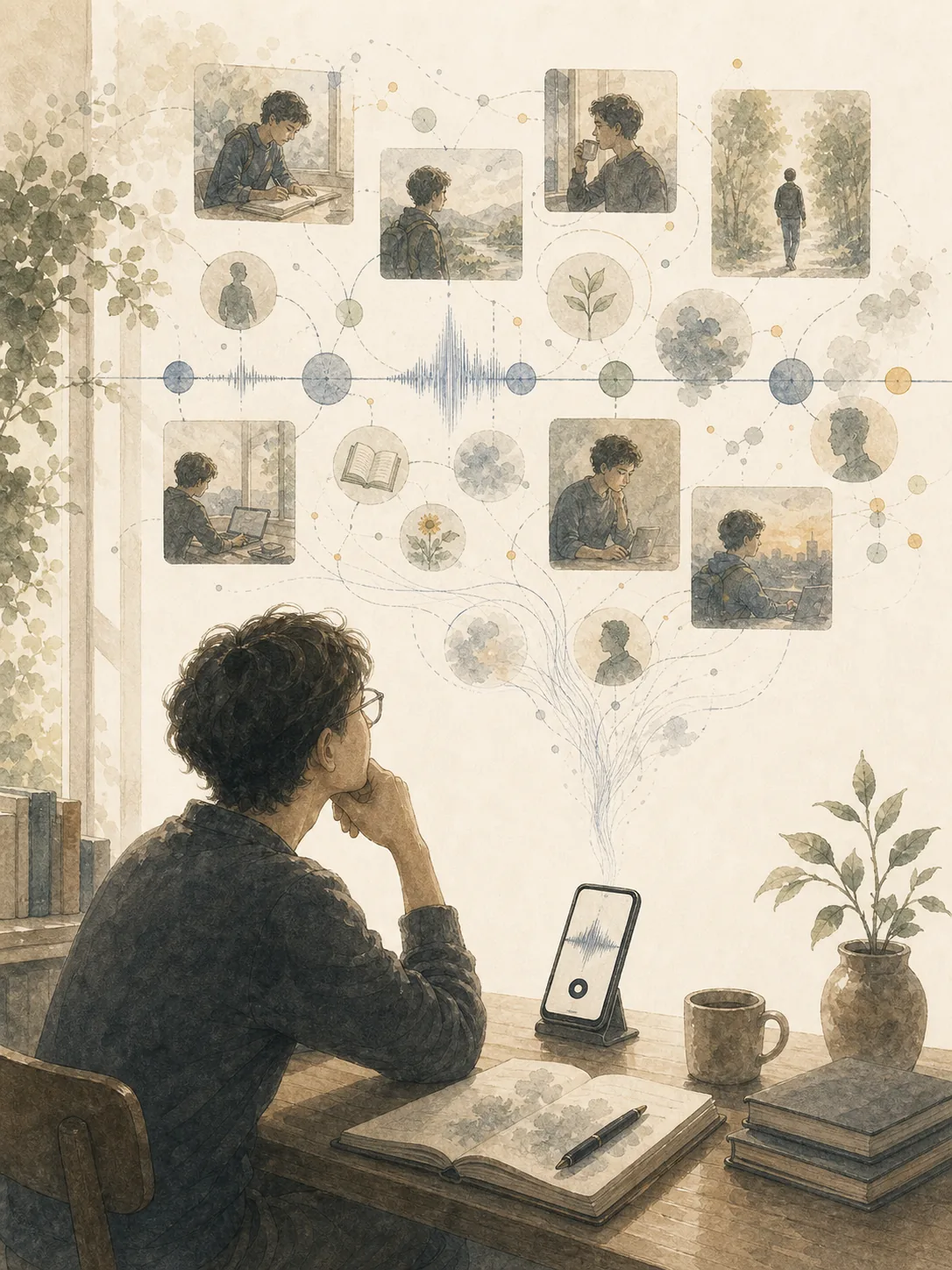
What were you worried about three months ago — do you remember?
You probably remember that period felt rough, maybe something at work, maybe a decision you hadn't made. But the specifics — what exactly it was, how it started, how it eventually passed — are already blurry.
That's how the brain works. It keeps the emotional color but drops the factual detail. Three months ago you were anxious — you remember that much. What you were anxious about, you probably can't recall.
What if you'd spoken a few sentences at the time? Even just: "Spent all afternoon frustrated about that project again. The problem is the timeline, not the tech."
Three months later, you'd look at that note and find two things. First, the anxiety was more specific than you remember — and smaller. Second, the problem resolved itself. What felt like a wall was really just a phase.
That's the value of recording. It doesn't require good writing. It doesn't need to be thorough. It just preserves a version of who you were at that moment, so the future you can come back and look.
You're repeating yourself without knowing it
After recording for a while, the first thing most people discover isn't some deep life insight. It's a slightly embarrassing fact: every few days, you're saying the same thing.
You thought your frustrations were different every day. Flip through the record and it turns out they're not. What you complained about last week and what you're complaining about this week are the same thing at the core, just wearing a different outfit.
This kind of repetition is invisible from the inside. You're living in the emotion every day — you can't see its shape. But once it becomes text and you look at it from the outside, the shape appears immediately: what's bothering you isn't a hundred different things. It's one thing showing up a hundred different ways.
Seeing it is where change begins.
Your memory lies — your records don't
Keep recording a bit longer, and you'll notice something even more interesting: the past you remember and the past in your records often don't match.
You remember a stretch of time as painful. But the records show that mixed in were plenty of calm, even happy moments — it's just that the brain kept the pain and filtered out the rest. You remember something bothering you for a long time. But the records show that from the first mention to the last, it was only two weeks.
This isn't bad memory. Psychologist Daniel Schacter, studying how memory distorts, found that human memory systematically deviates from fact — we beautify, compress, and reconstruct, stitching scattered experiences into a story we can live with. This is normal brain function, but it means the "last year" in your head may be quite different from the year that actually happened.
A record is a copy of yourself that can't be tampered with by your brain. When you open it later, what you see isn't the memory's processed version — it's who you actually were at that moment.
Why most people can't keep it up
The concept makes sense. But why can't most people keep recording past two weeks?
Because "recording" in most people's imagination means "writing a diary." Open an app, face the screen, organize your language, choose your words, write a couple hundred words. You're already tired, and this becomes yet another item on your to-do list.
Once the bar is high, "every day" becomes "when I have time," which becomes "forget it."
But recording doesn't have to mean writing. It can mean speaking.
Walking somewhere, you take out your phone and say a few sentences: "Project finally passed review today, went better than expected. Thinking tonight about why I was so nervous beforehand — probably because I got stumped last time." Thirty seconds, and you're done.
The problem is that ordinary voice input produces text that's full of filler words, missing punctuation, no paragraph breaks. Cleaning it up afterward turns it right back into a writing task.
Flow Keyboard turns what you say into clean text directly — filler words removed, punctuation and paragraphs in place. What comes out is a record ready to save, no further processing needed.
A few minutes a day. Over a year, that's hundreds of thousands of words — a chronicle of yourself. You don't need to write it. Just speak.
Recording isn't about remembering
What people who frequently record themselves ultimately discover isn't "I remember more things."
It's that you start seeing yourself from the outside — seeing what you keep repeating, seeing what your memory has been rewriting, seeing that the thing that kept you up three months ago is long since gone.
Try it today. Say something about how you're feeling right now. You don't have to write. Just speak.
Turn your voice into clean, usable text.
Flow Keyboard goes beyond dictation — it removes filler words, adds punctuation, organizes paragraphs, and smooths out your logic. Speak naturally, get text you can use.
References
- Schacter, D. L. (2001). *The Seven Sins of Memory: How the Mind Forgets and Remembers*. Houghton Mifflin.